

Bedrooms often accumulate more belongings than expected. Clothing, luggage, accessories, bedding, documents, seasonal items, and everyday essentials all need dedicated storage. Well-planned Wardrobes can organize these items without making the bedroom feel unnecessarily crowded.
This is particularly relevant in New Delhi apartments, where bedrooms may need to deliver substantial storage within limited floor space.
Wardrobe Planning Should Begin With Your Belongings
A common mistake is deciding the exterior design before planning the internal arrangement.
Start by examining what needs to be stored. Someone with a large collection of formal clothing may require more hanging space, while another person may need additional drawers, shelves, or luggage storage.
A practical wardrobe can include different zones for:
- Long hanging garments
- Shirts and jackets
- Folded clothing
- Accessories
- Shoes
- Bedding
- Luggage
- Valuables
- Frequently used items
The proportion of each section should reflect the user's lifestyle.
Sliding or Hinged Wardrobes?
Both systems can work well, but room conditions matter.
Hinged shutters provide direct access to individual sections and allow the complete wardrobe frontage to be opened in stages. They can also accommodate accessories on the inside of shutters where the design permits.
Sliding shutters do not swing outward, which makes them useful where clearance between the wardrobe and bed is limited.
However, sliding systems require appropriate tracks and hardware, and one shutter generally overlaps another. Selection should therefore consider accessibility as well as available space.
Use Vertical Space Carefully
A full-height wardrobe can make productive use of vertical space.
Upper cabinets are useful for luggage, blankets, seasonal clothing, and items that are not required every day. Frequently used clothes should remain within comfortable reach.
Creating excessive shelves at inconvenient heights can technically increase storage capacity while making the wardrobe less practical.
Internal Dimensions Matter
Storage efficiency depends heavily on dimensions.
Hanging sections require enough depth for clothes to sit comfortably. Drawers need suitable height for their intended contents. Shelves that are too deep can result in belongings being forgotten at the back.
Before fabrication, dimensions should be planned around what each compartment will hold.
Coordinate the Wardrobe With the Bedroom
Wardrobes occupy a large visual area and therefore strongly influence bedroom aesthetics.
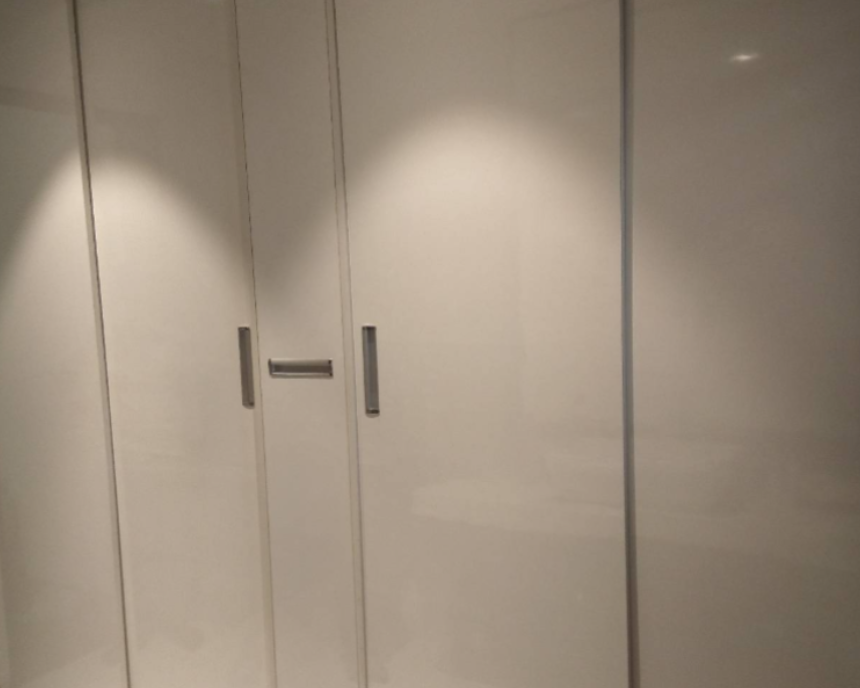
Possible finishes include laminates, natural veneer, decorative surfaces, glass combinations, mirrors, and other interior finishes. Neutral tones can help large wardrobes appear visually lighter, while wood finishes can introduce warmth.
The best choice depends on flooring, wall colours, bed design, lighting, and the overall interior concept.
Plan for Delhi's Everyday Conditions
Delhi's dust and seasonal climate should also be considered when selecting wardrobe materials and finishes.
Easy-to-clean surfaces can be valuable in frequently used rooms. Proper shutter alignment helps limit unnecessary gaps, while good hardware supports smooth operation over repeated use.
Ventilation within the room also matters. Furniture should not be expected to solve building-level dampness or persistent wall seepage.
Do Not Treat Hardware as an Afterthought
Hinges, channels, tracks, handles, and internal accessories determine how the wardrobe feels in everyday use.
Large shutters require appropriately selected hardware. Sliding wardrobes need reliable track systems. Drawers should open smoothly without excessive movement.
Hardware selection should correspond to shutter dimensions and expected usage rather than being chosen solely according to price.
For homeowners, designers, and residential project professionals in New Delhi, Madhav Tradelink works across modular furniture and interior furnishing requirements, including storage solutions that can be coordinated with other interior elements.
The most useful Wardrobes are ultimately designed from the inside out. Begin with belongings, divide them into logical storage categories, establish practical dimensions, and then select the exterior style. This approach makes better use of available bedroom space while creating storage that remains convenient long after installation.