A television unit has to do more than frame the screen: it must support equipment, hide wiring, preserve viewing comfort and leave enough clearance for people to move around the room. By the end, you will know which design suits your space, which measurements to take and what to demand from a manufacturer before fabrication.
Key takeaways
- Measure screen width, stand footprint, viewing distance and socket positions first.
- Leave ventilation around amplifiers, routers and gaming consoles to prevent heat buildup.
- Use removable back panels and cable channels for easier access and maintenance.
- Confirm board thickness, edge treatment, wall fixing and hardware before fabrication.
What a custom TV unit can solve in your living room
A custom TV unit solves more than a storage problem: it hides cables, houses equipment, uses awkward wall space and keeps the television visually balanced with your seating. Unlike a decorative stand, it is planned around the television’s actual width, depth, stand footprint, socket positions, cable exits and soundbar clearance.
| Option | Main advantage | Limitation |
|---|---|---|
| Ready-made console | Quick installation and predictable proportions | Fixed dimensions may leave cables, sockets or equipment exposed |
| Carpenter-built unit | Flexible on-site changes | Finish, hardware and cable planning depend heavily on workmanship |
| Modular furniture system | Repeatable parts and organised assembly | Modules may not suit unusual walls, corners or narrow access routes |
| Custom TV unit | Room-specific storage, proportions and service access | Requires measured drawings and careful fabrication |
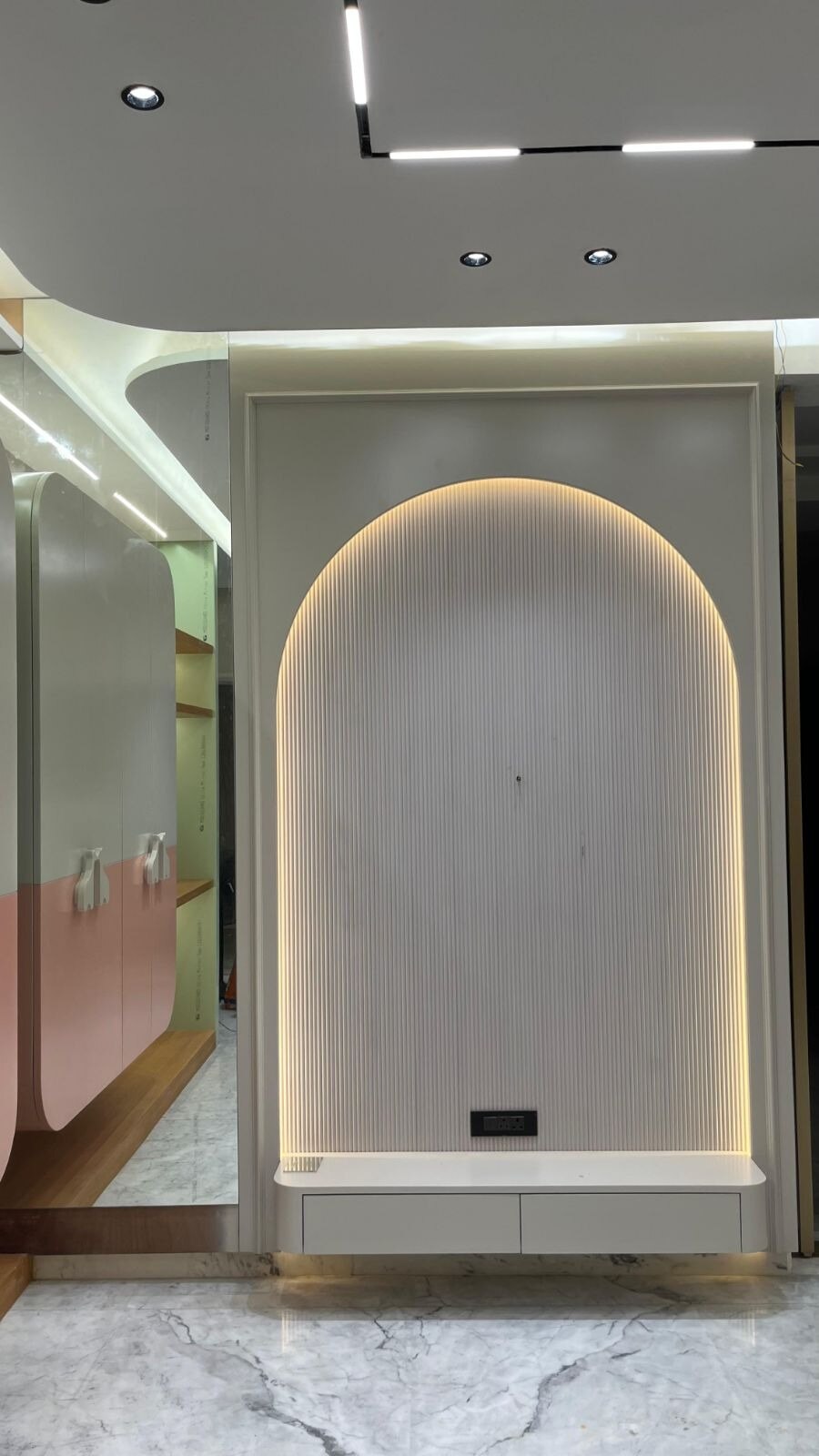
Consider Modern TV Unit Designs according to the problem in your room. A low storage console suits a clean layout and easy access; a full-height media wall adds enclosed storage and visual impact; corner units recover wasted space.
Open niches keep remotes and devices accessible but collect dust, while closed cabinets reduce clutter and need ventilation.
A floating console creates an uncluttered floor line, but its fixings must suit masonry, concrete, brick or gypsum board. Never rely on a decorative panel for support. Measure the soundbar before fabrication: a front rail or shelf can block its drivers or upward-firing Dolby Atmos channels.
How to size the unit around your screen and room
Measure the television, seating and circulation space before choosing the unit’s dimensions. Custom TV Units should be sized from the screen’s actual width, depth, stand footprint and cable exits—not from the advertised diagonal alone.
A 16:9 55-inch screen is about 48 inches wide, while a 65-inch screen is about 57 inches wide, before adding the bezel and stand.
| Dimension | How to decide | What to prevent |
|---|---|---|
| Width | Make the console wider than the television, then check speakers, side clearance and wall proportions. | A cramped edge, unstable stand or blocked doorway |
| Height | Set the screen centre from your seated eye position and seating geometry. | Neck strain from a fixed 42-inch centre height |
| Depth | Include the television, stand, plugs, cable bend and equipment depth, then preserve the walking route. | Protrusion into circulation space |
A low sofa, recliner or unusually tall seating position changes the comfortable screen height. Sit in your normal viewing position, measure from the floor to your eyes, and align the screen centre near that level; tilt the display only when the mounting height forces it.
For depth, mark the unit’s front edge on the floor with tape and walk past it carrying a tray or opening nearby doors. Reduce the projection if it narrows the route or collides with a recliner.
Floating Custom TV Units also need anchors matched to masonry, concrete, brick or partition construction; fixing only to a decorative panel is unsafe.
How to plan storage, cables, ventilation and sound
Plan the TV unit as three systems: a cool equipment zone, a cable route and household storage. TV Units with Storage work best when an AV receiver, set-top box or console has its own ventilated compartment instead of sharing an airtight cabinet with linens or books.
1. Measure every device before fabrication, including its depth, power cable, remote-control clearance and heat output. Leave removable equipment accessible from the front or through a serviceable rear panel.
2. Measure the soundbar separately. Keep its drivers clear of a shelf edge, front rail or decorative panel, and preserve the clearance specified for upward-firing Dolby Atmos channels.
3. Route power, HDMI, network and speaker cables through generous grommeted openings. Put sockets inside accessible cable zones, not behind fixed shelves, and label each route so a failed cable can be replaced without dismantling the unit.
4. Separate open display niches from closed storage. Open shelves keep remotes and devices within reach but show dust; shutters hide household items and visual clutter but need ventilation openings, clearance and durable hinges.
Modern TV Unit Designs should also include ventilation at the rear, top or sides of heat-producing compartments. Never seal an AV receiver or game console into a tight box.
Request a shop drawing before production. It should mark wall elevations, socket positions, cable paths, ventilation openings, material build-up, hardware and the installation sequence, including how large panels will pass through your doorway, lift or staircase.
Which construction details protect the unit and the television
Compare the construction, not only the finish. A 55-inch television is about 48 inches wide and a 65-inch model about 57 inches wide before bezel, stand and cable clearance; the carcass must fit those actual measurements.
| Option | Construction strengths | Risks and checks |
|---|---|---|
| Ready-made console | Factory-cut panels, fixed hardware and predictable assembly | Limited depth, ventilation and cable access; verify stand footprint, shelf load and soundbar clearance |
| Carpenter-built unit | Flexible dimensions and on-site adaptation | Quality depends on jointing, board thickness and installation; demand braced shelves, service access and secure wall fixing |
| Modular furniture system | Repeatable components, documented hardware and easier replacement | Confirm modules fit lifts, staircases and doorways; inspect joins, cable routes and ventilation before delivery |
| Custom manufacture | Shop drawing can coordinate dimensions, storage zones, materials, hardware and installation sequence | Require VESA-compatible bracket fixing, load-rated fasteners, reinforced carcass and approval of every measurement |
A sealed compartment around an AV receiver, console or set-top box traps heat, so TV Units with Storage need ventilated doors or openings. Long shelves need shorter spans, thicker boards, a central divider, front rail or concealed steel support; laminate alone will not prevent sagging.
Measure the soundbar before fabrication and preserve its specified front and upward clearance. A wall-mounted television needs a bracket matching its VESA pattern and rated load; never treat the cabinet as the primary structural support unless its carcass, wall fixing and fasteners were engineered for that weight.
What to ask a Custom TV Unit Manufacturer in New Delhi before fabrication
Ask the Custom TV Unit Manufacturer for a dimensioned shop drawing before approving fabrication. It should show wall elevations, the television’s actual width, depth and stand footprint, socket locations, cable routes, ventilation openings, material build-up, hardware and the installation sequence.
Include the soundbar’s measurements and required clearance; a front rail or shelf can block its drivers and upward-firing Dolby Atmos channels. Madhav Tradelink can be judged by whether it documents these room-specific decisions rather than relying on a catalogue sketch.
| Evidence | What to check | Why it matters |
|---|---|---|
| Shop drawing | Wall elevations, cable paths, sockets, fixing points and ventilation openings | Exposes clashes before cutting; confirms a modular unit can pass through doors, lifts and staircases |
| Material specification | Board type, thickness, edge sealing and declared formaldehyde class such as E1 | E1 is an emission class, not “formaldehyde-free”; sealed edges resist swelling |
| Support detail | Shelf spans, central dividers, stiffening rails or concealed steel supports | Laminate does not stop a long shelf sagging under books or speakers |
| Fixing schedule | Screw, bracket, anchor and wall-substrate details | Plasterboard, brick and concrete need different fixings |
Before installation, ask the installer to confirm wall level, moisture or air-conditioner drain risks, raised-plinth height, television bracket capacity, cable access, ventilation clearance and door alignment. Require a final test with the television, soundbar and equipment in place, including safe opening access and no pinched cables. A moisture-resistant board is still not waterproof.
Frequently asked questions
What can a custom TV unit solve in a living room?
It can organise equipment, conceal cables, use awkward wall space and keep the television balanced with the seating area.
How do you size a custom TV unit around the screen?
Measure the television’s actual width and depth, stand footprint, socket positions, viewing distance and the clearance needed for a soundbar.
How should a TV unit handle storage, cables and ventilation?
Plan separate storage for devices, cable exits near each connection point, removable access panels and ventilation openings around heat-producing equipment.
Which construction details protect a TV unit and television?
Check board thickness, edge treatment, strong wall fixing, level installation, suitable hardware and clearances around the screen and equipment.
What should you ask a Custom TV Unit Manufacturer in New Delhi before fabrication?
Ask for the final dimensions, material and finish specifications, cable and ventilation plan, fixing method, hardware details, installation scope and revision process.
Keywords